


As we remember the anniversary of D-Day, 100-year-old Royal Marine veteran Jim Gettings has shared his memories of service, sacrifice and survival during WWII.
Jim’s war effort began long before he joined the Royal Marines. As a teenager, he worked on a farm in North Yorkshire, helping to bring in the harvest using horse-drawn equipment. He later became a fire watcher during the Blitz and, aged just 16, survived being blown into the air when a parachute mine exploded in the street.
“I thought the parachute was a man,” Jim recalled. “I was going to get him!
"I was either fearless or daft, which is probably the same thing.”
Still only 16, Jim joined a Home Guard anti-aircraft battery, firing rocket guns at enemy aircraft before finally enlisting in the Royal Marines at 18.
“I couldn’t wait to get into my uniform,” he said. “When I got in the Marines, I was in the big time.”
Jim served with the 28th Battalion Royal Marines, which was used as infantry in Holland and Germany. In Holland, his unit held the south bank of the River Maas while German forces occupied the north. He remembers life on the front line as dangerous, but embraced it as part of the job.
“You know the bullets are zipping about,” he said.
“Any day one might get you, but that’s what you signed on for, isn’t it?”
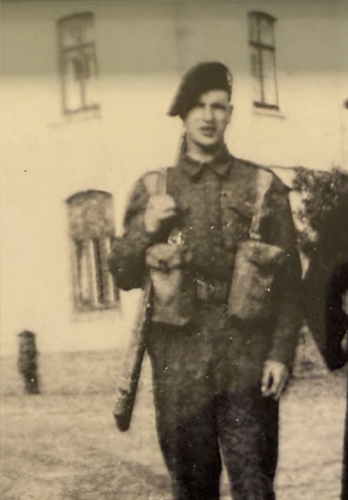
From Holland, Jim and his comrades advanced across Germany, sleeping rough with blankets tied around their packs and moving by open wagon. After Hitler’s death on 30 April 1945, his unit drove through German lines and across minefields without a shot being fired, before reaching Lübeck and taking over barracks there.
“We marched around the city square to show it had been officially occupied by the British. There was no band or drum, only the sound of boots and thousands of civilians watching in silence."
Despite all he endured, Jim says he never hated the enemy. After the fighting ended, German soldiers drifted in and spoke with their former opponents.
“No hatred,” Jim said. “More like comradeship.”
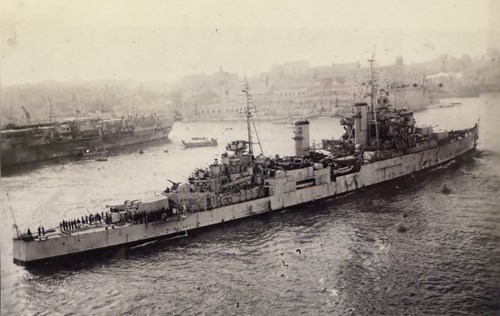
After the war in Europe, Jim served aboard HMS Superb and was sent towards Trieste, where Allied forces moved to prevent Tito’s partisans taking control. He remembers preparing both parade uniform and battle kit, unsure whether they would be marching through the city or landing under fire.
Now aged 100, Jim remains deeply modest about his service.
Asked if he considers himself a hero, he is clear.
“No. The lads who didn’t come back were the best and the bravest. They were the heroes.”
For Jim, remembrance is about those who never returned.
“We have to remember all the people that didn’t come home,” he said. “We gave our today for your tomorrow.”
If you'd like to support WWII veterans like Jim, and the wider military community as a whole, you can do so by playing the Veterans' Lottery.


